Who is the shrimptrawler?
A sidebar-click, a 14-year YouTube channel, and the completeness of a very online creative universe.
Recently I stumbled upon the shrimptrawler YouTube channel, in an “old YouTube” style of discovery: the sidebar. I happened upon a “Strat-O-Matic” video like this one. These videos appear to be Excel-based simulations of baseball seasons from 1972 to 1975, following the Strat-O-Matic system. Each one features a screen recording of an Excel spreadsheet similar to this:
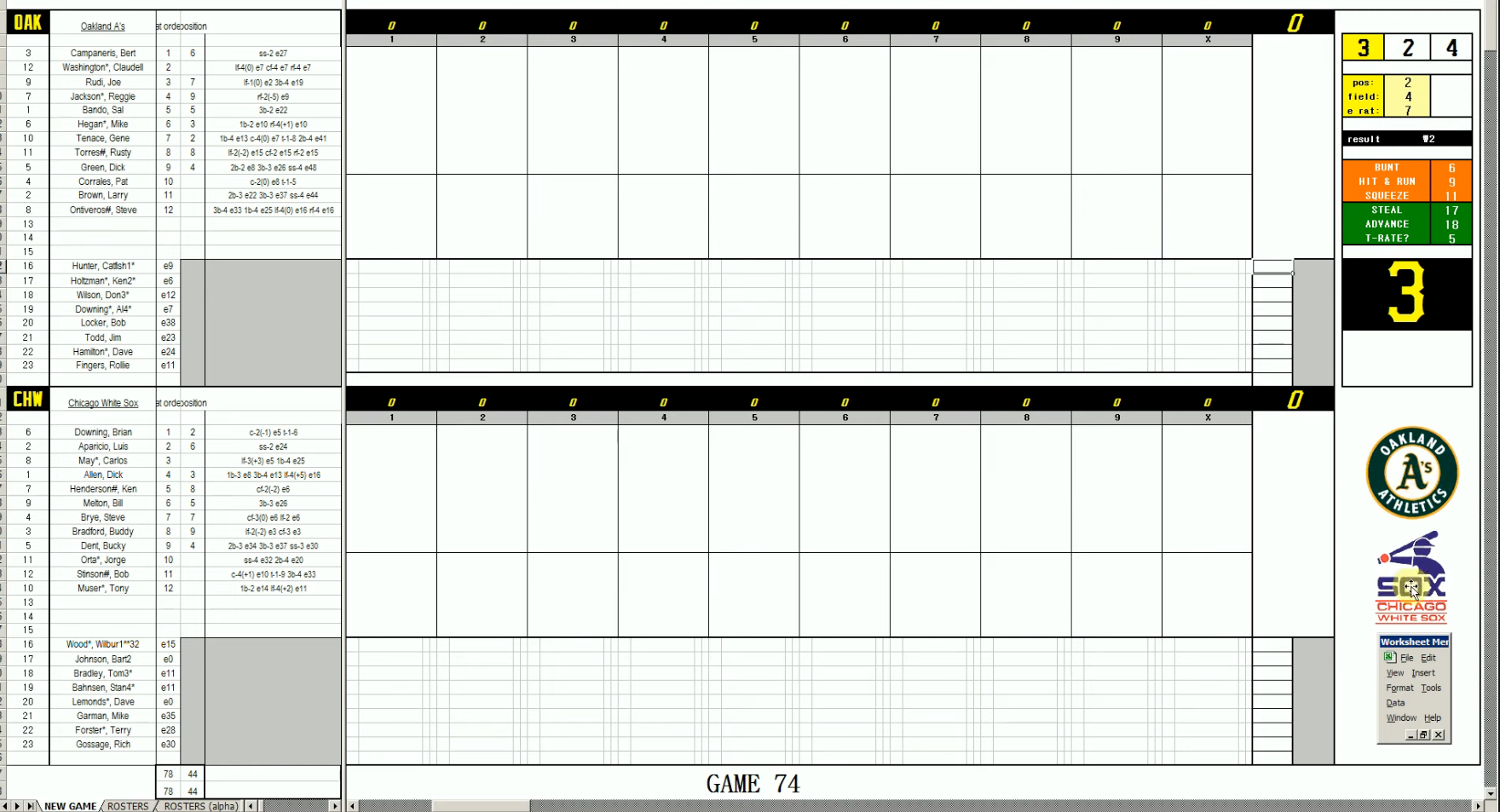
They are generally 40 to 60 minutes long, with a running voiceover from a friendly, confident voice. They appear to be playing 4 year carryover leagues, starting by going through rosters and player cards, and moving into game simulations. The individual doing the voiceover appears to also be manipulating the screen, simulating games through some macros. The channel helpfully has each league laid out into playlists.
What really struck me about this channel at first was the sheer number of videos: there are over 1,500 videos uploaded to this channel over the course of 14 years. The person (or persons?) behind this channel is a prolific content creator. While they only have 234 subscribers, they do have nearly 109k views across their entire channel for an average of about 73 views per video.
I’M CARLOS NOW
As I was checking out this channel, I noticed a series of videos also uploaded to it about a TV series called I’M CARLOS NOW. I had never heard of this series, so I googled it. I found a Weebly site dedicated to the show, and then links only back to the shrimptrawler YouTube channel. So what is I’M CARLOS NOW?
The Weebly site links to a doc (here’s a Scribd link from the creators) that calls I’M CARLOS NOW “a 13-episode experimental American TV series…created by Lawrence Johns and Paul Flum”. The Weebly site links to a full episode listing on shrimptrawler.net, where it appears that the series finished at 3 seasons and a total of 39 episodes.
Who is the shrimptrawler?
The shrimptrawler, it turns out, is Paul Flum — which is itself a stage name. I’m not going to put his actual name here, though he publishes it himself on his own site. He started out in Baltimore in 1992 playing bass and singing in a grunge trio called Helikopter. He later adopted the “Paul Flum” alias, borrowing it from a character played by Al Franken in the 1986 film One More Saturday Night, and kept it for subsequent projects including The Uniform, UV-373, Flum Rampage, and Athenapolis. “The Shrimptrawler” itself is the title of an album he released in 1999.
Flum moved from Baltimore to Portland, Oregon in 2005 and has been prolific ever since. His site, shrimptrawler.net, reads as a decades-long timeline of music releases, films, photo essays, and assorted internet artifacts going back to 1992 — CDs, a text adventure game, a DIY multi-part adaptation of an epic poem, and in 2024, a novel called Henri Edson Ximenez about a Baltimore punk rocker cursed by a hex in New Orleans. The YouTube channel is essentially the distribution arm for everything he makes — including, apparently, hundreds of hours of baseball sims in Excel.
Who is Lawrence Johns?
Lawrence Johns is an American epic poet, also based in Portland, and Flum’s longtime collaborator. His LinkedIn lists his education as The Graduate Theological Union in Berkeley — a detail that surfaces in I’M CARLOS NOW, where the protagonist Frank attends GTU in Episode X (“The Prodigal Son”). He lists his title as Founder & President of the Western Way Institute.
He has at least three published epic poems:
- Love And Hate (2005) — about the rise and fall of Haight-Ashbury
- Beyond Exile (2008) — a Cold War / 1970s-terrorism narrative, and the source material for I’M CARLOS NOW
- The Western Way (2023) — a “lyrical and philosophical examination of contemporary America”
The Amazon copy for The Western Way — which reads like it was written either by Johns or by someone doing very enthusiastic PR on his behalf — calls him “America’s greatest epic poet” and positions him as “the primary contender to supplant Billy Collins as America’s most popular poet.” Make of that what you will.
The Western Way Institute
The Western Way Institute is the umbrella under which Johns and Flum have been working together since at least 2011, when Athenapolis — Flum’s band — released their first album as a collaboration with Johns and Johns’ son. In the years since, the Institute has put out:
- the Stories of the Will trilogy: The Red Dream (2014), Caridwen (2015), and Peredur (2016)
- Listen Sagaxi (2017), a filmed series of short lectures by Johns
- I’M CARLOS NOW (2017–2020), 39 episodes across 3 seasons
- Integrated Memory Glyphs (2018), an experimental project built from stray IMG-filename uploads on YouTube
- Thirteen Selected Poems (2021), drawn from I’M CARLOS NOW
- Seattle Rock Today (2022), a 4-episode sequel set in the early 1990s Pacific Northwest music scene
- an I’M CARLOS NOW soundtrack (2023)
The whole thing is small, self-produced, and very online in a way that feels specifically pre-algorithmic — which I admire. It brings me back to an older, more authentic World Wide Web that I’ve been missing dearly.
What strikes me, coming out the other side of this, is the completeness of it. There’s a band, a poet, a production company, an epic poem, a 39-episode TV adaptation of the poem, a soundtrack to the TV show, selected poems pulled back out of the TV show, a sequel series, a novel, and — running underneath all of it, uploaded day after day for fourteen years — 1,500 videos of a guy playing Strat-O-Matic in a spreadsheet. The internet is so much bigger than the parts of it that win.
I have huge respect for people who create like this…people who make things because they want it to exist, not because an audience is waiting for it. It’s easy to measure creative work by what breaks through (viral videos, bestsellers, amazing product marketing launches, follower counts). Instead, Flum and Johns have spent literal decades building a whole interconnected body of work that doesn’t seem to have broken through. And yet here it all is, for anyone who happens to be clicking through the YouTube sidebar.
That’s the kind of creative life, in my middle age, I find myself admiring more than I ever thought I would.
P.S. — The Western Way Institute’s website has fallen off of the web, but you can click through what it once was via the Wayback Machine.