The Rise of the CDP Automation Application
What's with all the new CDP + Workflow tools?
The Customer Data Platform (CDP)
Traditionally, a CDP functions as a headless tool designed to create a comprehensive dataset of customer information. These platforms focus on:
- Integration of customer data from multiple sources
- De-duplication of data and customer records
- Persisting information to data warehouses
Early category leaders include Segment and Amplitude, with PostHog offering an open-source alternative.
Co-opting the CDP
Recent years have witnessed numerous tools marketing themselves as Customer Data Platforms, spanning diverse categories:
- customer.io
- Atlan
- Pocus
- Census
- Hightouch
- Klaviyo
These tools encompass marketing platforms, data catalogs, reverse ETL systems, and sales accelerators — yet all claim CDP positioning. This trend connects to automation capabilities.
Workflows are processes
Workflows represent step-by-step processes triggered by specific conditions. Think of making oatmeal: a trigger initiates sequential actions toward a desired outcome.
Automation
Historical business processes relied on human execution. Modern automation replaces manual work with computer-driven systems, delivering superior efficiency and consistency compared to human-performed tasks.
The distribution of automation and growth of SaaS
Automation evolved from embedded database functions through third-party schedulers (Control-M, ActiveBatch, JAMS) and RPA tools. Approximately a decade ago, code-first orchestrators (Airflow, Prefect) emerged, dramatically lowering barriers for embedding workflow automation into SaaS applications.
The CDP Automation Application
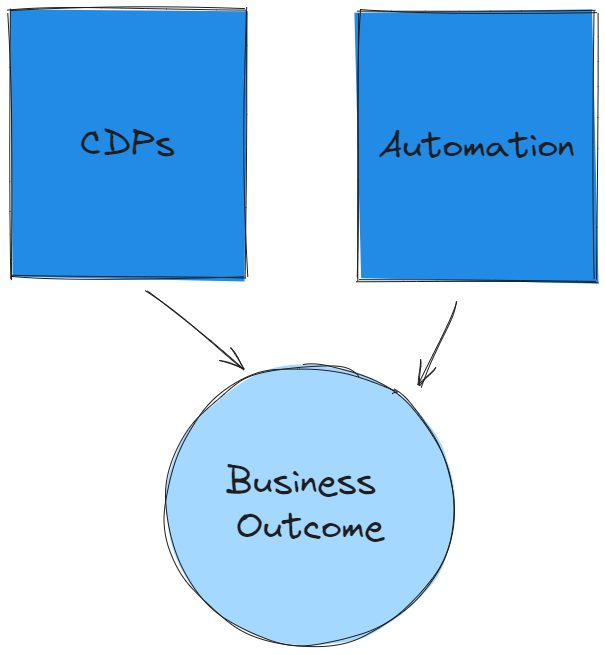
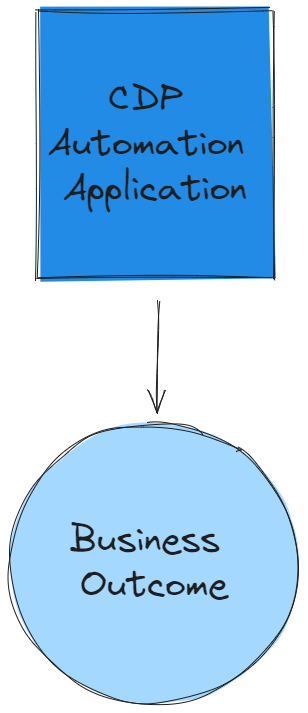
CDPs serve automation — they always have. Automation requires data triggers, and unified customer information enables actionable workflows. Modern CDP Automation Applications merge three capabilities users demand:
- Unified data visibility
- Action execution capabilities
- Integrated single platform
What’s next?
I predict market expansion rather than consolidation. Less technical users and audience-specific segments (GTM, marketing) will adopt tailored CDP automation solutions, potentially graduating to enterprise-grade tools as requirements expand. Competition drives innovation across the CDP landscape.